
The Lectionary
It's such a simple thing, just a list of readings.
I was first introduced to the Revised Common Lectionary (RCL) in my seminary homiletics course as a Protestant. Our instructor was a Baptist. He used the RCL at his church, and it was an easy way for him to assign texts for us to preach on in a fairly impartial manner.
For the next seven or eight years, the only “lectionary” that I experienced was the expectation that in December I would preach on the Nativity, and Palm Sunday and Easter would cover the triumphal entry and the resurrection. Besides that, what I chose to preach about was pretty much up to me.
Once I entered the Army, the lectionary came back as a means of assigning texts for our “preaching lab” in basic training. About a year into my first assignment, I began to look to the lectionary for use in worship. My initial motivation was to introduce more scripture into the service—four readings are better than one, I reasoned. (I discussed this some last week in case you missed it.)
When I deployed to Iraq and was again in charge of my own chapel, I began using the RCL pretty faithfully to drive the content of my preaching. I found it was too easy to gravitate to my favorite passages without something directing me to offer a more balanced diet. With the lectionary giving (typically) an Old Testament reading, a Psalm, an Epistle reading and a Gospel reading, even if I wasn’t preaching on all four texts, at least my congregants were hearing them. Maybe that was the word they needed for the day, regardless of whatever I was talking about.
When I became Anglican, I was officially bound to use the lectionary. We used a slight variation of the RCL, if I recall. Depending on which Prayer Book you followed for your service, the lectionary could differ significantly. Some only had a one-year cycle of readings, while others had a three-year cycle. As the Anglican group I was affiliated with started to coalesce a bit, they decided to begin work on their own prayer book and lectionary.
Creating a good lectionary is not easy. Usually, there is a Sunday lectionary for Sundays and other major feast days (like Christmas, etc.) This tries to follow the liturgical calendar, taking into account the various seasons of the church year; Advent, Lent, Easter, Ordinary Time, and so forth.
One of the challenges is the variability of Easter. It can fall anywhere from March 22nd to April 25th. This means the period from Christmas to Ash Wednesday expands and contracts from year to year, as does Ordinary Time on the other side. If you aren’t careful, you can create readings that are almost never read, depending on how you address these things.
There is also a daily lectionary, for use during the week. In addition to the Easter challenge, we see a similar issue with the 4th week of Advent. It can last from 1 to 7 days, depending on which day of the week Christmas falls in a given year, so we get the readings for the Saturday of the fourth week of Advent pretty rarely.1
In case you haven’t discerned this already, this is the kind of systems-nerd sort of thing that I can really get into, and I did. When my Anglican body came out with their new lectionary, I took great interest…and was greatly disappointed. I’ll spare you the details, partly because they have grown a bit fuzzy in my memory after a decade, but I remember they failed to address the “Easter shift” in a very adept manner in my assessment.
As I made my way across the Tiber and into the Catholic Church, I knew they also had a lectionary. (Where do you think the Anglicans got the idea?) As I got to know it, I found that it was well designed, with minimal sections that get “dropped” with the variations in movable feasts. It follows a three-year cycle for Sundays and feast days, and a two-year cycle for the daily readings. I’ve been through it a couple of times at this point.
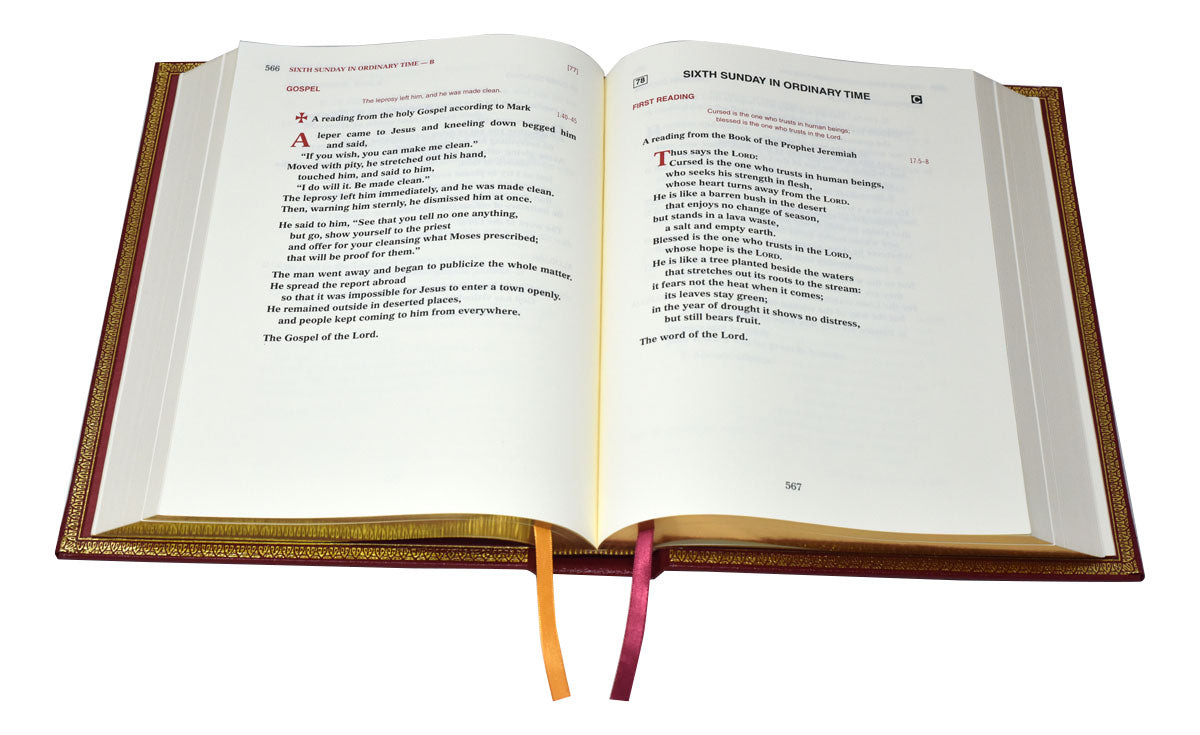
Having a year-long reading plan that covers the events of Christ’s life, as well as other significant narratives within Scripture gives a pretty balanced diet. It doesn’t cover every verse of Scripture, but if you read the Sunday and daily readings every day, you’ll get 90% of the Gospels, 55% of the rest of the New Testament, and 13.5% of the Old Testament.2 Not comprehensive, but a reasonable minimum diet. I’d argue it’s a more balanced diet than most “Bible churches” serve over the same period of time.
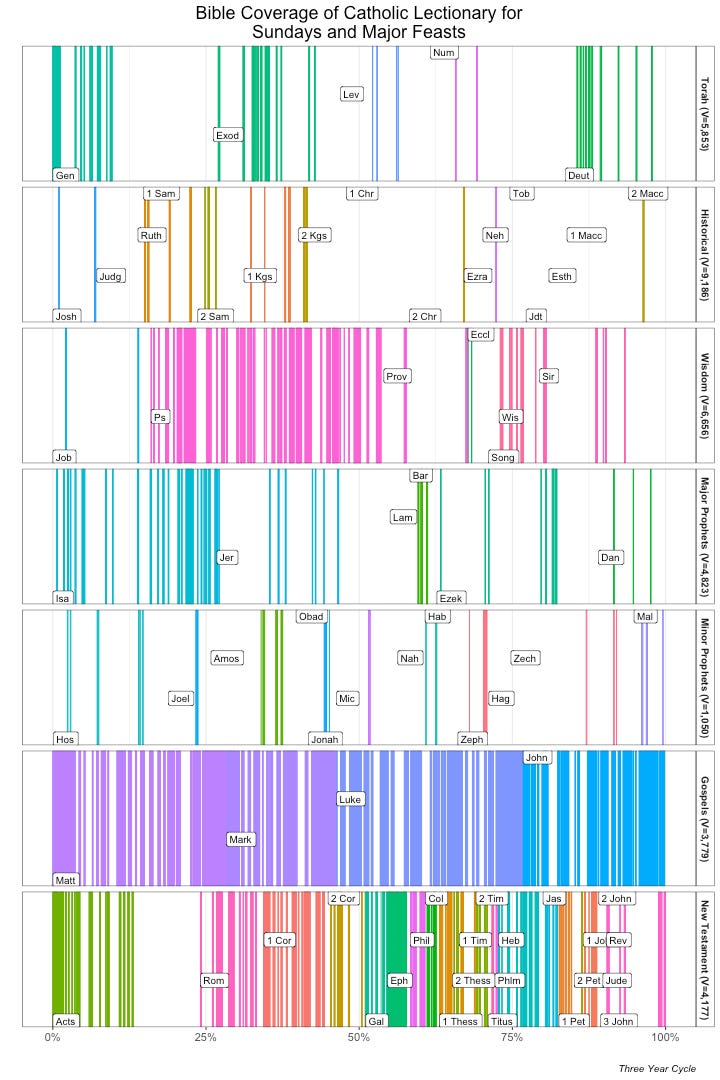
If one prays the Liturgy of the Hours, to include the Office of Readings, there is more extended Scripture in the first reading each day. I don’t have a resource that shows what that adds. It might increase the Old Testament some, but probably not a significant percentage.
What does all this have to do with me becoming Catholic, which is the theoretical thread of this series? It’s not a major piece of the puzzle, but it does factor in. The existence of a lectionary, especially one prescribed by the authority of the Church, speaks to a few things.
First, it speaks to authority. The Church dictates the lectionary. We don’t get to make it up and that’s a good thing in my view. We’ll unpack authority in a future post.
Second, it speaks to unity. If Catholics around the world are reading the same texts each day, that is a instrument of unity. We are all (literally) on the same page. This applies not just to a select day, but to the following of the Church year as well. It fosters a certain solidarity in the practice of our faith.
Third, it speaks to preparedness. If I am so inclined, I can study the readings before Mass. I usually at least read through them once so I am not getting them “cold” at Mass and this helps me to engage with them. It is also an aid to study. I have files on my computer set up for each day’s readings. If I find something interesting related to one of them, I can just make a link. I am slowly building my own reference library.
If you’re a lifelong Catholic, I hope I’ve helped you appreciate the gift you experience in the lectionary. If you come from a tradition that doesn’t follow a lectionary, maybe I’ve given you something to ponder about the scriptural diet your parish serves.
Grace & peace,
Chris
Only in a year where Christmas falls on Sunday.
https://catholic-resources.org/Lectionary/Statistics.htm